Pearson Edexcel · GCSE · History
Course version: 1HI0 · Version from Sept 2016
C1000–c1500: Crime and punishment in medieval England - 2 The nature of…
Full specification wording
Option 10: c1000–c1500: Crime and punishment in medieval England - 2 The nature of law enforcement and punishment: The role of the authorities and local communities in law enforcement in Anglo-Saxon, Norman and later medieval England, including tithings, the hue and cry, and the parish constable.
Throughout the medieval period, law enforcement relied on local communities rather than a professional police force.
Checked against the Pearson Edexcel 1HI0 specification (opens in a new tab) on .
- Point 1 of 2
- 4 key terms
Study notes
From the checked teaching notes for this specification point.
The idea
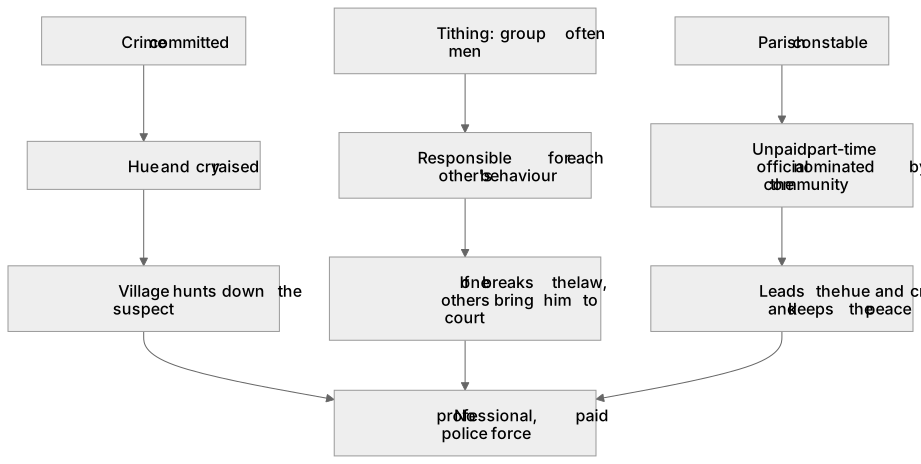
Throughout the medieval period, law enforcement relied on local communities rather than a professional police force. In Anglo-Saxon and Norman England, the tithing system required groups of ten men to be responsible for each other's behaviour; if one broke the law, the others had to bring him to court. The 'hue and cry' was another community duty, where anyone witnessing a crime had to raise the alarm, and the village was obligated to hunt down the suspect. In later medieval England, the role of authorities expanded slightly with the introduction of the parish constable. This unpaid, part-time official was nominated by the community to lead the hue and cry and keep the peace, representing a shift towards more formal local policing.
What earns the marks
- Describe the tithing system as a form of collective responsibility in Anglo-Saxon and Norman law enforcement.
- Explain the 'hue and cry' as a mandatory community response to catching criminals.
- Identify the parish constable as an unpaid, part-time law enforcement officer introduced in later medieval England.
- Compare the heavy reliance on the local community in the early medieval period with the gradual introduction of appointed officials later on.
- Explain that there was no professional, paid police force during this entire period, making community participation essential.
Common mistakes and how to put them right
Describing the parish constable as a modern, paid police officer.
Put it right: Emphasise that the parish constable was an unpaid, part-time role filled by local men for a year.
Confusing tithings with the hue and cry.
Put it right: Distinguish tithings as a preventative group of ten men, while the hue and cry was the active pursuit of a criminal by the whole village.
Stating that the Normans completely abolished Anglo-Saxon law enforcement.
Put it right: Note that the Normans kept effective community systems like tithings and the hue and cry.
Exam tips
- Emphasise the concept of 'collective responsibility' when discussing tithings and the hue and cry.
- Use the parish constable to demonstrate change over time in later medieval law enforcement.
- When evaluating law enforcement, highlight that its effectiveness depended entirely on the willingness of the local community to participate.
Try the lesson
The start of the Option 10: c1000–c1500: Crime and punishment in medieval England - 2 The nature of law enforcement and punishment: The role of the authorities and local communities in law enforcement in Anglo-Saxon, Norman and later medieval England, including tithings, the hue and cry, and the parish constable. lesson, made from checked teaching notes for this specification point.
Have a go first
In medieval English law enforcement, what was the 'hue and cry'?
Listen
Throughout the medieval period, law enforcement relied on local communities rather than a professional police force. In Anglo-Saxon and Norman England, the tithing system required groups of ten men to be responsible for each other's behaviour; if one broke the law, the others had to bring him to court. The 'hue and cry' was another community duty, where anyone witnessing a crime had to raise the alarm, and the village was obligated to hunt down the suspect. In later medieval England, the role of authorities expanded slightly with the introduction of the parish constable. This unpaid, part-time official was nominated by the community to lead the hue and cry and keep the peace, representing a shift towards more formal local policing. A strong answer earns marks for these points. Describe the tithing system as a form of collective responsibility in Anglo-Saxon and Norman law enforcement. Explain the 'hue and cry' as a mandatory community response to catching criminals. Identify the parish constable as an unpaid, part-time law enforcement officer introduced in later medieval England. Compare the heavy reliance on the local community in the early medieval period with the gradual introduction of appointed officials later on. A common slip: Describing the parish constable as a modern, paid police officer. Instead, Emphasise that the parish constable was an unpaid, part-time role filled by local men for a year. Exam tip: Emphasise the concept of 'collective responsibility' when discussing tithings and the hue and cry.
See it
Key words
Say what each word means before you turn the card.
Tithing
Try answering aloud or in your head before turning the card.
Hue and cry
Try answering aloud or in your head before turning the card.
Parish constable
Try answering aloud or in your head before turning the card.
Collective responsibility
Try answering aloud or in your head before turning the card.
See every definition
- Tithing
- A group of ten men who were responsible for each other's behaviour, and if one broke the law the others had to bring him to court.
- Hue and cry
- A community duty where anyone witnessing a crime had to raise the alarm, and the village was obligated to hunt down the suspect.
- Parish constable
- An unpaid, part-time official nominated by the community to lead the hue and cry and keep the peace in later medieval England.
- Collective responsibility
- The idea that groups such as tithings and the whole village shared responsibility for behaviour and for catching criminals.
Label the diagram
Some boxes have lost their names. Pick the right name for each number.
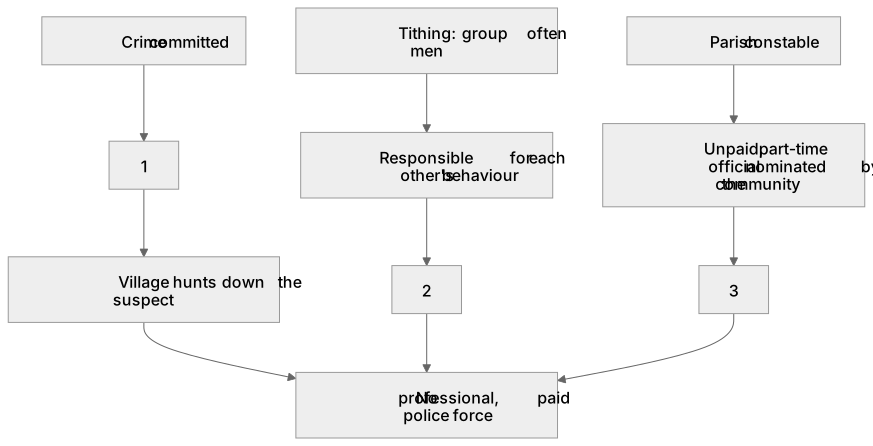
1Box 1
2Box 2
3Box 3
There is more to this lesson
The full lesson goes on to check your understanding and help you earn the marks. Create a free account to carry on, with your progress saved.
A week of Premium from your first lesson · Then the free plan continues · No card, no charge
Test your understanding of Option 10: c1000–c1500: Crime and punishment in medieval England - 2 The nature of law enforcement and punishment: The role of the authorities and local communities in law enforcement in Anglo-Saxon, Norman and later medieval England, including tithings, the hue and cry, and the parish constable.
Active recall beats re-reading. Take an instant quiz now to test what you’ve learned and lock it into long-term memory.
A week of Premium from your first lesson · Then the free plan continues · No card, no charge